


3-Day Full-Body Workout for Beginners: A Simple Gym Plan
Published by Liftlog+ · Updated
A three-day full-body workout does not need three different routines. Start with one manageable session, repeated on three nonconsecutive days: a squat, a press, a row, a hip hinge and a trunk exercise. Keep the movements consistent, record what you actually lift, and add repetitions before adding weight.
This plan is for generally healthy adults beginning gym resistance training. The goal is to build basic strength, give muscle growth a starting stimulus and learn a routine you can repeat—not to maximize every muscle’s training volume immediately. Get instruction on unfamiliar movements and equipment before loading them. This is a general template, not an individualized or clinically tested program.
The plan at a glance
Train on Monday, Wednesday and Friday, or another three-day schedule with at least one nonlifting day between these sessions. Repeat the table in the same order each time.
You need dumbbells, a flat bench, a seated cable-row station and floor space. Allow about 35–50 minutes, including warm-up, rest and equipment changes. Your first sessions or a busy gym may take longer; this is a planning estimate, not a timed circuit.
| Exercise | Working sets | Repetitions or time | Rest between sets |
|---|---|---|---|
| Dumbbell goblet squat | 2 | 8–12 reps | 2–3 minutes |
| Dumbbell bench press | 2 | 8–12 reps | 2–3 minutes |
| Seated cable row | 2 | 8–12 reps | About 2 minutes |
| Dumbbell Romanian deadlift | 2 | 8–12 reps | 2–3 minutes |
| Front plank | 2 | 15–30 seconds | About 1 minute |
A working set is one of the planned challenging sets, not a lighter rehearsal set. Finish both sets of an exercise before moving to the next; take enough transition time to set up safely. Rest longer when you need it to repeat the movement with control.
For the four rep-based exercises, aim to finish with roughly two or three good repetitions still possible. For planks, stop before your position or breathing becomes difficult to maintain. The effort guidance below explains how to apply this without testing your limit.
If you are completely new: use one working set per exercise during your first week while learning the setup. Move to the table’s two sets when you are comfortable with the movements and recovering between visits. You do not need to earn soreness or exhaustion.
Warm up and choose your starting weights
Start with a few minutes of easy movement, then rehearse the first exercise without a load or with a very light one. Before each new loaded movement, do one or two easy practice sets, gradually approaching your intended working weight if needed. Keep these brief and comfortable rather than turning them into extra hard sets.
For your first working set, choose a load you expect to lift for eight controlled repetitions with a few more still available. There is no universal beginner weight and no need to test a one-repetition maximum for this plan.
- If eight reps feel close to your limit, or you cannot keep the movement controlled, stop and reduce the load for the next set.
- If eight reps are very easy, keep practicing or make a small increase after resting. Do not jump repeatedly toward a maximum just to find the “perfect” weight.
- If you are unsure, choose the lighter option. The first visits are also information gathering.
Record how the weight is counted. For a two-dumbbell exercise, “10 kg per hand” is clearer than “20 kg,” which could mean either the pair or each dumbbell. The same applies to pounds. Cable-stack numbers are specific to that machine; do not treat them as equivalent across different stations.
A few cues for each movement
These cues are reminders, not a substitute for a demonstration. Use the linked exercise library to identify the variation, and ask a qualified coach or gym staff member for help with unfamiliar equipment.
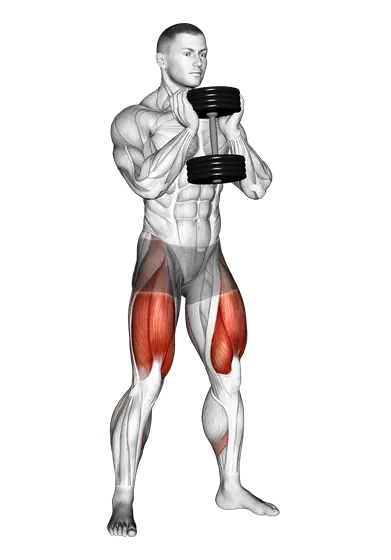
Hold one dumbbell close to your chest, keep your feet planted and squat to a depth you can control. Do not chase extra depth by losing balance.
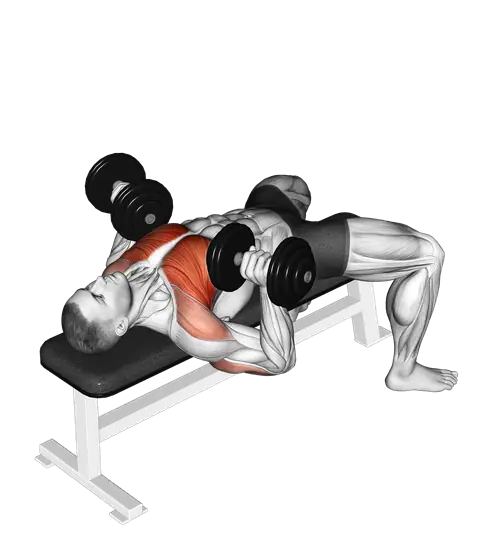
Use a flat bench, plant your feet and lower the dumbbells under control. Learn how to get into and out of position before choosing a heavier pair; do not rely on dropping the weights.
Use the linked variation's overhand grip, with palms facing down. Pull toward your torso without turning each rep into a backward body swing.
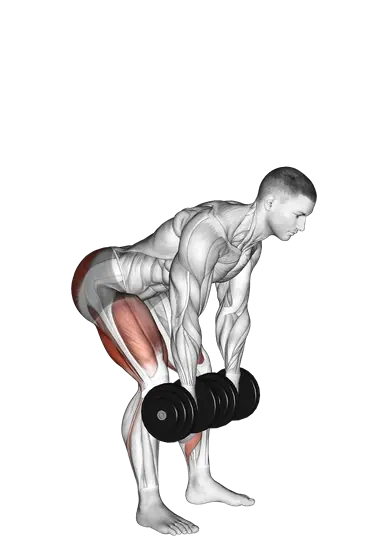
Start standing with the dumbbells close to your legs. Keep a small knee bend, send your hips back and stop the descent where you can still control your trunk. The dumbbells do not have to reach the floor.
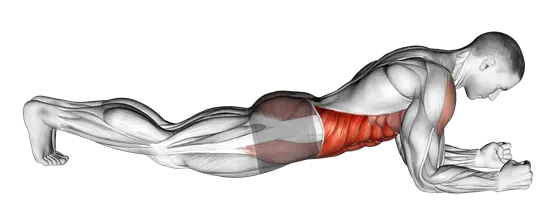
Support yourself on forearms and toes, keep your hips from sagging and breathe normally. A shorter controlled hold is preferable to a longer hold with a collapsing position.
Stop a movement if it causes pain. Do not use the substitution list as a way to train through pain; persistent or concerning symptoms need appropriate professional assessment.
How hard should the sets feel?
“Two or three reps left” means you estimate that you could perform that many additional repetitions with the same technique—not by swinging, shortening the movement or getting help. This is often called repetitions in reserve, or RIR. It is an estimate, especially when you are new.
You do not need to prove the estimate by continuing until you fail. A systematic review of failure versus non-failure training found that reaching failure was not necessary for strength and muscle-size gains in the young adults studied. The evidence does not establish one exact effort target for everyone, and a small trained-lifter subgroup favored failure for muscle growth.
For this introductory plan, the buffer is a practical way to keep challenging sets repeatable. The 2026 ACSM position stand also discusses training short of failure, while acknowledging uncertainty about exact RIR targets. If technique deteriorates before the planned repetitions, end the set rather than forcing the number.
Progress with reps first, then weight
Use this simple double-progression rule for the four exercises with an 8–12-rep range:
- Keep the same load while building repetitions within the range. The two sets do not have to match.
- When you reach 12 reps on both sets, with the intended buffer and consistent technique, on two comparable sessions, try the smallest practical weight increase at the next session.
- After increasing, work from the lower end of the range again. If the new load prevents eight controlled reps with a buffer, return to the previous load.
The two-session check is this plan’s conservative decision rule, not a research-proven magic threshold. You are not required to add weight every week.
Worked example: dumbbell bench press
These are illustrative sessions, not an expected rate of progress. Loads are per dumbbell; the metric and pound examples are alternative equipment increments, not exact conversions.
| Comparable session | Load per hand | Set 1 | Set 2 | Next decision |
|---|---|---|---|---|
| First | 10 kg or 20 lb | 10 | 8 | Keep the load |
| Later | Same load | 11 | 10 | Keep building reps |
| Later | Same load | 12 | 12 | Repeat before increasing |
| Next comparable session | Same load | 12 | 12 | If technique and buffer remain, try the next small increment |
| After increase | For example, 11 kg or 22.5 lb per hand | 9 | 8 | Build reps again |
If your gym jumps straight from 10 to 12.5 kg per hand, that is a substantial step. Do not force it. Keep the old load, look for smaller increments or use a suitable machine with finer adjustments. Changing exercise or machine starts a new comparison; its numbers are not interchangeable with your dumbbell history.
For the plank, add a few seconds only while you can keep the same position and breathing. Once both holds reach 30 seconds comfortably, maintain them while you learn the other movements rather than chasing ever-longer holds. Ask for guidance before adding a harder trunk exercise.
A notebook is enough: write the exercise, load, actual reps for each set and a short effort note. If you prefer an app, the strength-training log guide explains how to compare like-for-like sessions. The record supports the decision; it does not require a personal best.
What if equipment is busy or a movement is unfamiliar?
Wait briefly, change the order if practical, or use a familiar substitute below. Keep your current working-set count (including the first-week one-set option), the 8–12-rep target and the effort buffer, but choose the load afresh. Record the change. Learn the substitute’s setup before loading it.
| Planned movement | Possible substitute | What changes |
|---|---|---|
| Goblet squat | Machine seated leg press | A supported knee-dominant exercise, not squat practice. Adjust the seat and use a controlled range without your pelvis lifting from the pad. |
| Dumbbell bench press | Machine chest press | A supported press. Adjust the seat and handles to a comfortable starting position; do not compare its stack number with dumbbell weight. |
| Seated cable row | Cable wide-grip lat pulldown | A vertical rather than horizontal pull. Use an overhand grip and pull in front of your head without swinging. It fills the pulling slot temporarily, not the identical movement. |
| Dumbbell Romanian deadlift | Machine lying leg curl | Trains knee flexion rather than a hip hinge. It is a temporary hamstring option while you arrange hinge instruction, not a complete replacement for the hinge’s role. |
For the plank, shorten the hold if necessary. If you cannot set up a controlled, comfortable version, leave it out and ask for help rather than improvising a harder variation.
Once you find comfortable choices, keep them stable for several weeks so your log remains useful. Repeatedly changing equipment makes it harder to tell whether the same task is improving.
Missed sessions, difficult weeks and stalls
Missed one day? Do the next session when you can, keeping a nonlifting day between these workouts. Do not double the sets or cram consecutive sessions together to restore a calendar streak. Two completed sessions are a better record than pretending you did three.
Only two days are realistic most weeks? Repeat the session twice on nonconsecutive days. The 2026 ACSM guidance supports resistance training at least twice weekly; three days is a schedule option here, not a prerequisite for progress.
Still unusually sore or fatigued at the next visit? Delay the workout or use a lighter, shorter session. Do not push through pain or a loss of normal movement. If the workload repeatedly interferes with the next session, return to one working set per exercise temporarily and reassess.
No progress for several comparable sessions? First check whether you changed technique, rest, equipment or exercise order. Keep rest long enough to repeat good reps, and review sleep and overall recovery rather than automatically adding sets. If a load repeatedly keeps you below the range, reduce it and rebuild. Persistent problems are a reason to seek individual guidance, not an instruction to train harder indefinitely.
After a longer break, treat the return as another starting-load session rather than resuming old numbers automatically.
Why full-body—and why only two sets?
Full-body training fits this plan because each visit practices the same basic movements and covers upper and lower body. It is not inherently superior to a split. A 2024 systematic review and meta-analysis found similar average strength and muscle-growth outcomes for split and full-body routines when training volume was matched.
At the table’s full dose, you do 10 working sets per session and 30 across the week: six each for the squat, press, row, hinge and plank. That does not mean 30 sets for each muscle. Some muscles contribute to several movements, and this is not a specialized plan for every body part.
Two sets keep the initial workload manageable. The 2026 ACSM overview supports multiple-set resistance training and distinguishes making progress from optimizing a particular outcome. Higher weekly volume can help maximize muscle growth, but that is a different goal from establishing a repeatable beginner routine. This starting dose is not optimal for everyone.
Keep using the template while the movements are comfortable, recovery is manageable and your log shows useful practice or progress. If you later want more emphasis on a particular muscle, a different schedule or help with persistent stalls, that is the time to revise the plan—not a reason to make week one complicated.
Sources and scope
The sources support the broad training principles, not this exact combination of exercises, sets and progression rules. Those details are practical programming choices for this article.
- ACSM, 2026: Resistance Training Prescription for Muscle Function, Hypertrophy, and Physical Performance in Healthy Adults: An Overview of Reviews. DOI: 10.1249/MSS.0000000000003897. Full-text strength, hypertrophy and discussion sections consulted; recommendations apply to healthy adults and require individual context.
- Ramos-Campo and colleagues, 2024: Efficacy of Split Versus Full-Body Resistance Training on Strength and Muscle Growth. DOI: 10.1519/JSC.0000000000004774. Abstract consulted; matched-volume results do not establish that one schedule is best for every beginner.
- Grgic and colleagues, 2022: Effects of resistance training performed to repetition failure or non-failure on muscular strength and hypertrophy. DOI: 10.1016/j.jshs.2021.01.007. Full-text results, discussion and conclusion consulted; the included participants were young adults, and the ideal distance from failure remained uncertain.
For general information only—not personalized training or medical advice. Historical routines may vary by source; adapt workouts to your experience and consult a qualified professional if needed.

